Contents
Overview
In SOVEREIGN, diplomacy is not a menu on the side but the way conflicts arise. The standard path to war is a diplomatic crisis: a nation makes a demand, both sides gather supporters, the situation escalates in stages – and at every stage someone can back down, a compromise can be found or the crisis can escalate further.
Demands
A crisis starts with exactly one demand on the target:
- Territory: individual land provinces or a whole region (never the capital),
- Reparations: a payment of up to a quarter of the target's GDP,
- Lift embargo: the target ends its embargo against the initiator,
- Leave alliance: the target leaves an alliance,
- Demilitarisation: a border region of the target stays free of troops for two years.
Every demand has a value in war score. It determines how much a compromise may cost and what a later war can enforce.
The escalation ladder
- 0 · Demand
- 90-day deadline, tension rises slowly
- 1 · Threat/sanctions
- mutual embargo of the two leaders
- 2 · Mobilisation
- higher troop upkeep, faster reinforcement, slightly lower goods output
- 3 · Ultimatum
- 30-day deadline – then war
- 4 · War
- war goal = the original demand
Stages and deadlines from Spec 23 §11 (default values).
Only the initiator can escalate, and no earlier than 30 days after reaching a stage. If a deadline passes on stages 0–2, the crisis lapses – and the initiator loses some stability. On stage 3, the expiry of the ultimatum leads to war; the target can also reject the ultimatum actively.
Other nations can join a side. Supporters raise the tension, worsen their relations with the other side and enter a war if it comes to that.
Outcomes
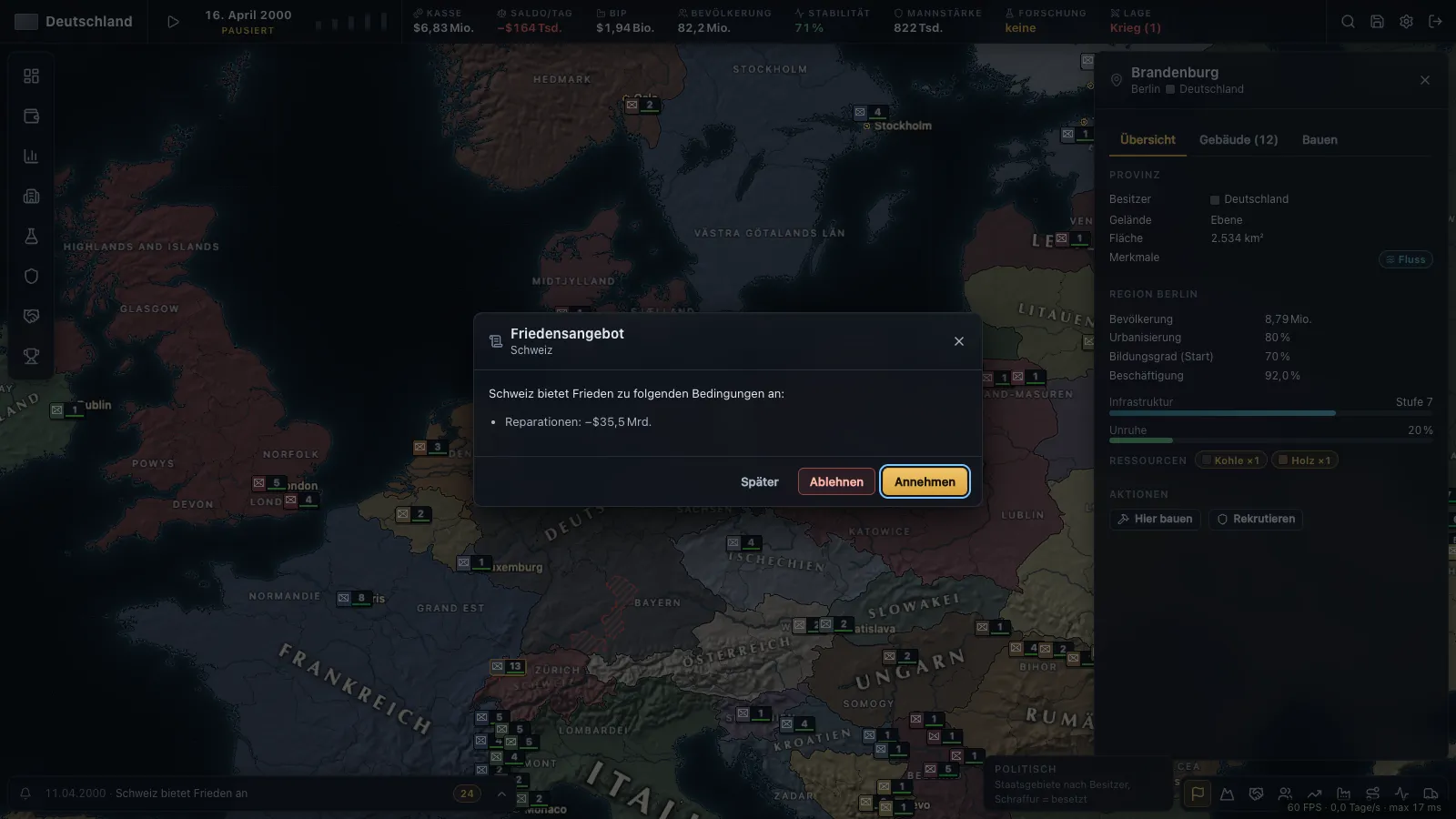
- Concede: the target fulfils the demand. It loses stability, the initiator gains a little.
- Back down: the initiator gives up and loses stability – and the trust of its supporters.
- Compromise: one side offers a smaller demand, the other accepts. Both sides improve their relations slightly.
- Lapse or war.
Except after a war, a one-year truce between the two leaders follows.
Effect on the world and markets
Crises do not stay between two capitals. Tension (0–100) lowers the stability of those involved; supporters bear half. From stage 1 the world market adds a risk premium on goods that the two sides supply in large amounts. The Tension map mode shows where things are heating up.
For experts: tension and risk premium
Example from the specification: Gulf states with a 25 % share of oil in an ultimatum ⇒ +5 % on the target price of crude oil.
Alliances and relations
The start scenario contains the alliances of the year 2000, among them NATO, the EU, the CIS and the Gulf Cooperation Council. New alliances are bilateral and always defensive. If a member is attacked, its defensive partners join automatically – the attacker's partners do not.
Relations between nations drift monthly towards a target value: alliances and similar forms of government improve them, aggressive neighbours worsen them. “Improve relations” raises a nation's opinion step by step – but only to a limited extent above its target value.
Sanctions and embargoes
An embargo works in both directions: for the nations involved, the partner's supply and demand no longer count on the world market. From stage 1 of a crisis, the two leaders automatically impose a mutual embargo that is lifted when the crisis ends. How embargoes act along trade routes is explained in the article Trade & chokepoints.
Declaring war – the direct path
A direct declaration of war without a crisis is possible but costly: no war goal, lost relations with third parties, lost stability – and the target's defensive partners join immediately. The diplomacy dialogue warns clearly against it.
For now, suggestions go through the Discord channel or the community page.
Derived from the specifications; measurements come from test runs of the prototype and are marked as such.