Diplomacy & crises
Wars do not begin with a declaration of war but as a crisis. Every stage has consequences – and either side can back down first.
First the crisis, then perhaps the war.
A nation makes a demand, both sides gather supporters, tension rises every day. Escalating requires waiting for deadlines – enough time to negotiate.
- Five kinds of demands. Territory, reparations, lifting an embargo, leaving an alliance or demilitarising a border region.
- Camps and supporters. Third parties take sides. That raises the tension and binds them if it comes to war.
- Five outcomes. Concession, backing down, compromise, an expired deadline – or war.
What each stage triggers.
| Stage | Name | Effect |
|---|---|---|
| 0 | Demand | Tension rises slowly, both sides look for supporters. |
| 1 | Threats & sanctions | Mutual embargo between the two leaders; the world market adds a risk premium. |
| 2 | Mobilisation | Higher troop upkeep, faster reinforcement, slightly lower production of goods. |
| 3 | Ultimatum | The target must decide: concede, offer a compromise or stand firm. |
| 4 | War | Supporters join, defensive alliances kick in; the demand becomes the war goal. |
Mechanics of the prototype (Spec 23 §11). Values are still being balanced.
War goals are cashed in at the negotiating table.
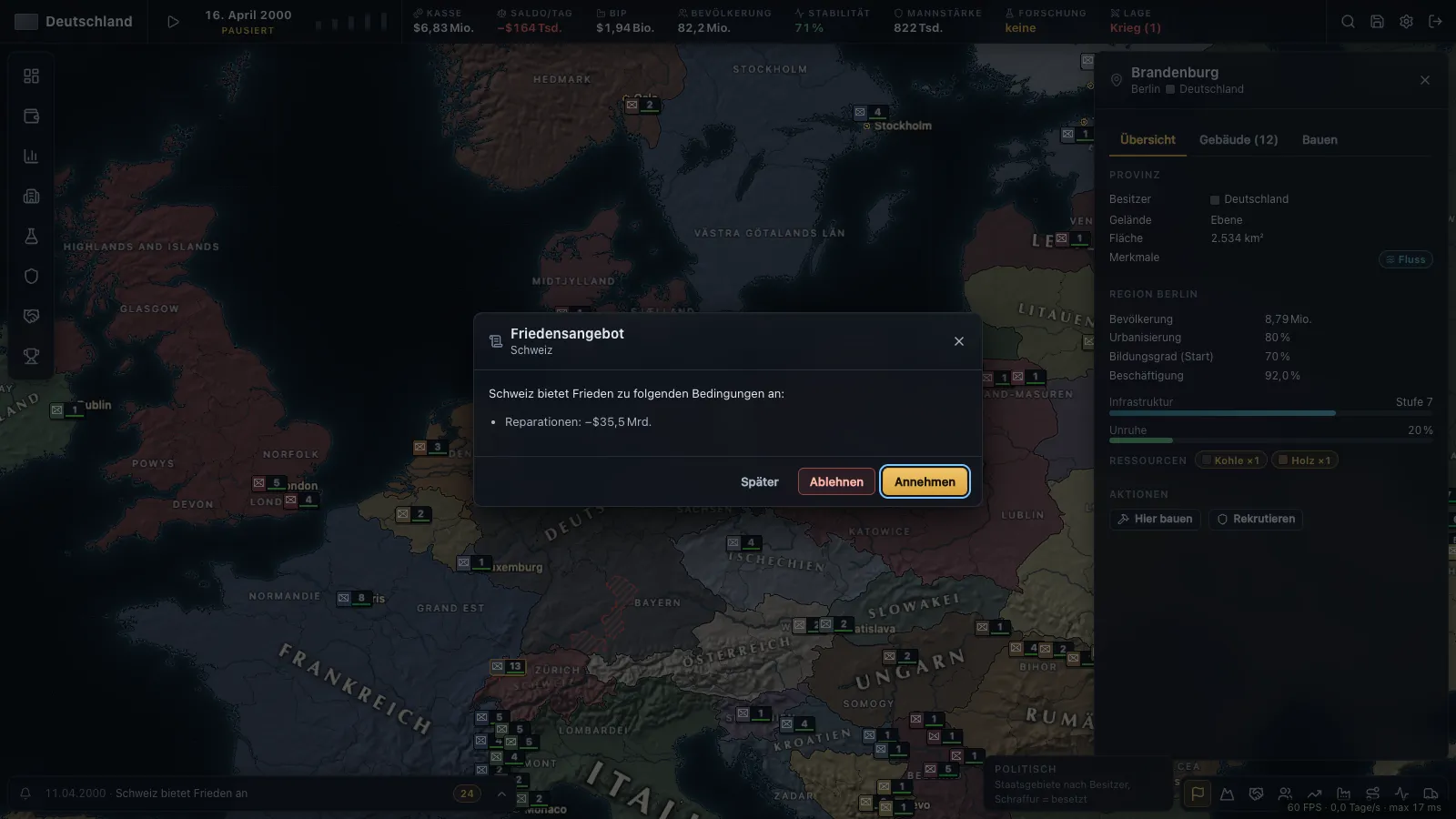
Occupation and losses produce war score. Peace offers demand provinces, reparations or the war goal of the crisis – the more score, the more can be enforced. Separate peace is possible.
- Alliance obligations. Defensive alliances pull partners onto the side of the attacked – without a chain reaction through partners of partners.
- War has a price. Declaring war costs relations with the target and third parties as well as your own stability.
- Markets feel crises. Goods produced mainly by the camps involved become more expensive on the world market.
Relations, alliances, organisations.
The 2000 scenario already contains alliances and communities such as NATO, the EU, the CIS and the Gulf Cooperation Council.
Alliances
Propose, accept or leave bilateral defensive alliances. Scenario alliances remain in place.
Relations
Opinions drift towards a target every month: alliances, similar forms of government and aggressive neighbours shift it.
Organisations & influence
Charters, voting rights, founding conferences and spheres of influence are planned in the game concept – in development.