Maps & scenarios
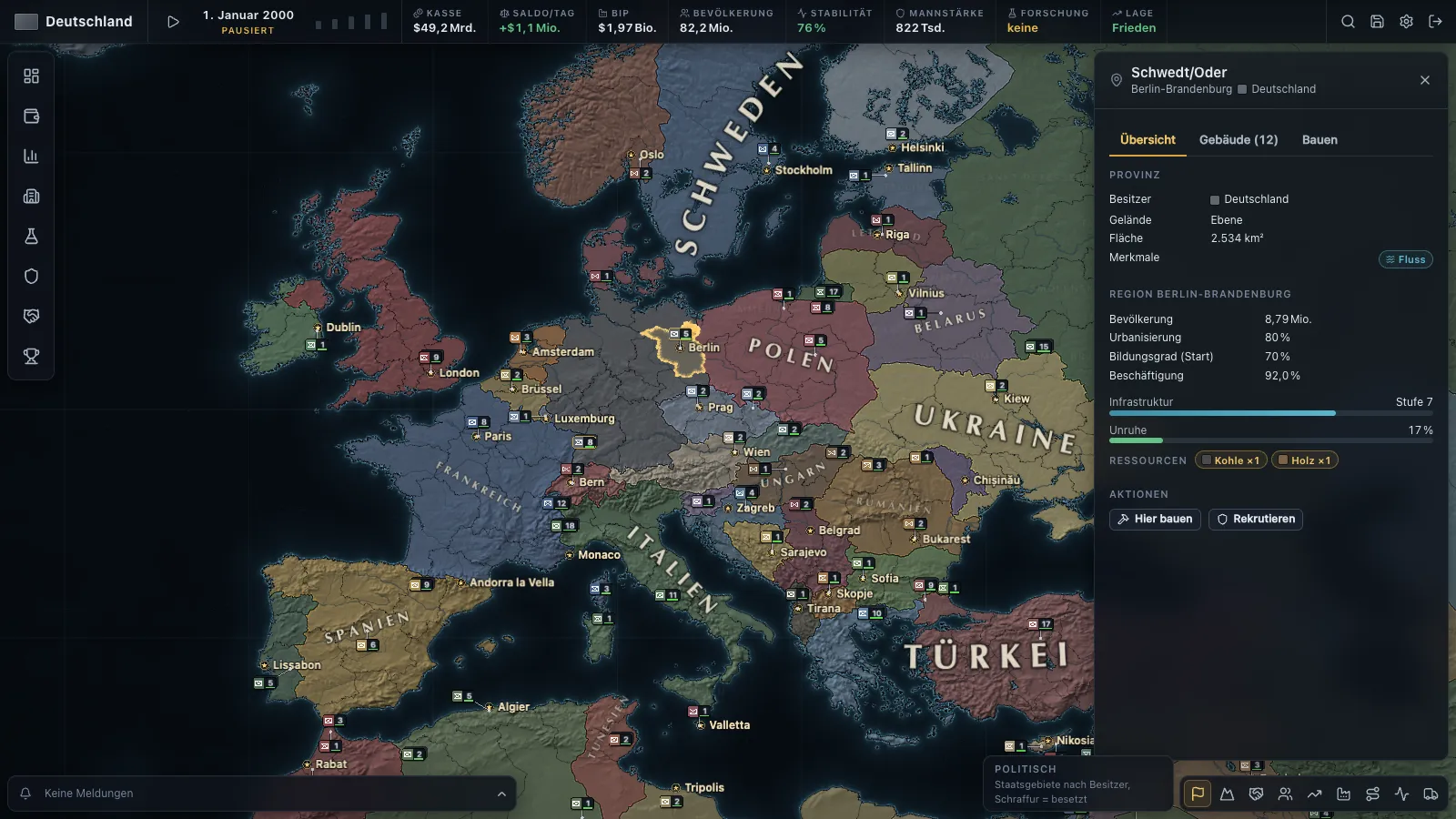
The campaign begins on 1 January 2000 – with real figures and sources. Further start dates will follow on the same province map.
The world at the turn of the millennium – with sources.
91 nations with GDP, population, budget, technology, alliances and armed forces. The basis is World Bank data (WDI, WGI); whatever cannot be measured is marked as a derived estimate.
- 362 regions, 3,129 provinces. The economy runs on regions, the military on the finer province graph.
- Alliances of the year 2000. NATO, the EU, the CIS, the Gulf Cooperation Council and others as the starting state.
- Sources per nation. Every nation lists its data sources in the codex.
Five start dates, one map.
| Start | Situation | Status |
|---|---|---|
| 1 Jan 2000 | Turn of the millennium, globalisation at its peak – main campaign | playable (prototype) |
| 15 Sep 2008 | The banking crisis begins – economic and crisis start | planned |
| 1 Jan 2014 | New tensions in Eastern Europe, upheaval in the Middle East | planned · separate editorial review |
| 1 Jan 2026 | The present – starting point for future players | planned |
| 1 Jan 2040 | Generated world situation from trend projection | planned · speculative |
From the game concept (§3.3). The province map is identical for all start dates; a scenario sets ownership, buildings, population, treaties and technology.
One world map, many excerpts.
All maps are derived from one world map and share provinces, regions and names. The first playable excerpt covers Europe, Russia, the Middle East and North Africa.
- World, regions, arenas. Besides the world map there are regional maps and smaller arena excerpts for short matches.
- External actors. In the first excerpt the USA, China, India and Japan act through the world market and diplomacy.
- Prepared for 1900. Province borders are cut so that later expansions can be added without re-cutting.
Disputed matters shown neutrally.
A game about the present needs clear guidelines.
De facto control
The map shows who controls an area. Claims and recognition are kept separately.
No assignment of blame
Ongoing conflicts are not scripted war events – the simulation decides what happens.
Sources required
Historical data sets carry sources and a review status.