Contents
Overview
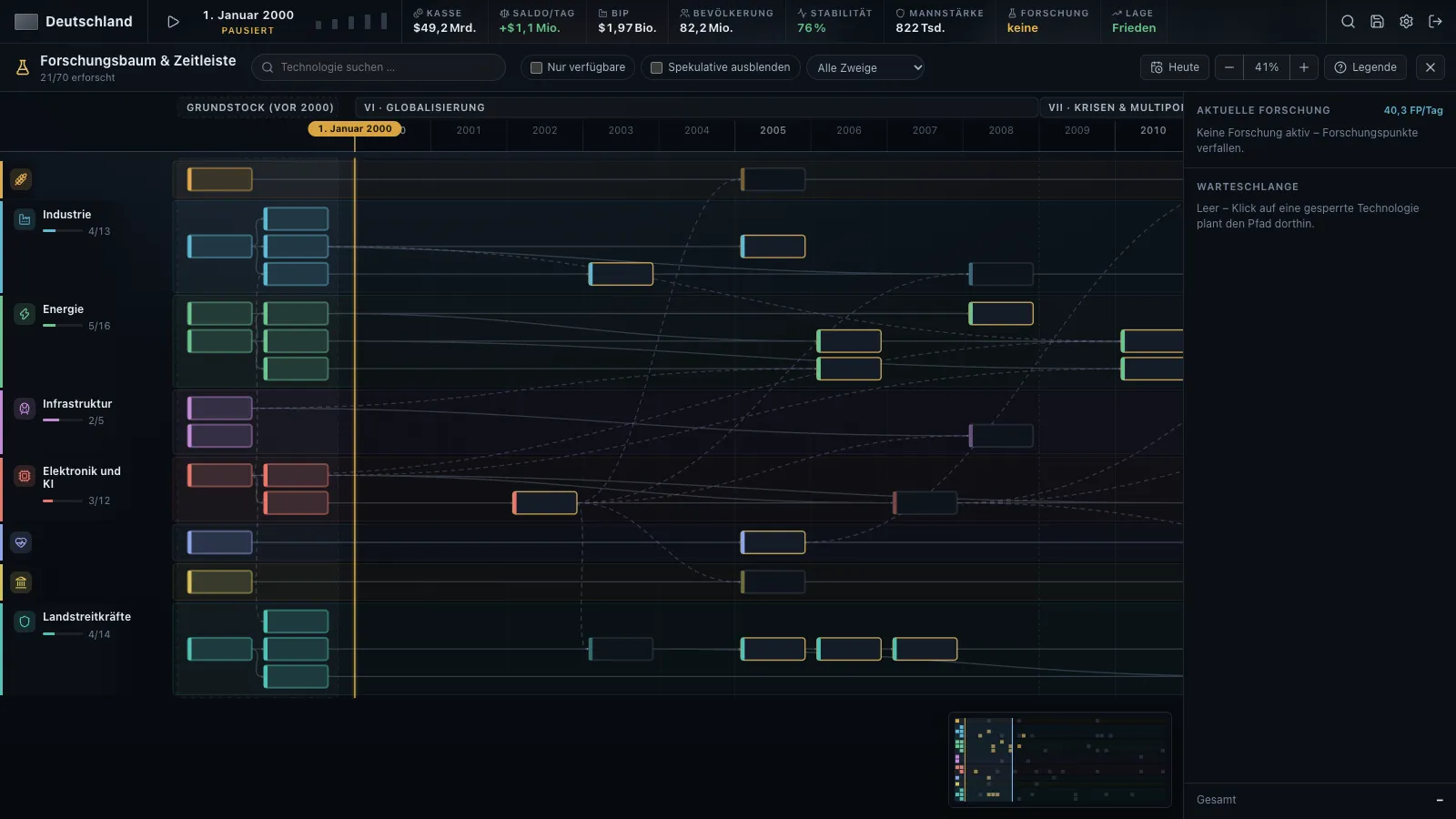
Every technology in SOVEREIGN has a historical year – the year it became widespread in the real world or (from 2027) is meant to be available by design decision. The research tree places all technologies on this timeline: one lane per branch, the past on the left, the future on the right.
- Technologies
- 167
- Branches
- 12
- Baseline nodes (before 2000)
- 34
- Speculative technologies
- 56, from 2028
- Time span
- 2000–2050
Numbers from the game data of the current build (content.json).
Branches and baseline
The twelve branches are industry, energy, electronics and AI, infrastructure, agriculture, medicine, administration, finance, space, and land, air and naval forces. Civil and military lines are deliberately linked: semiconductors help the economy as much as the air force.
Everything before the year 2000 is researched in the start scenario as the baseline – nuclear power, mobile telephony or containerisation, for example. These nodes are designed so that later expansions can split them into individual technologies without breaking saves.
Researching ahead and falling behind
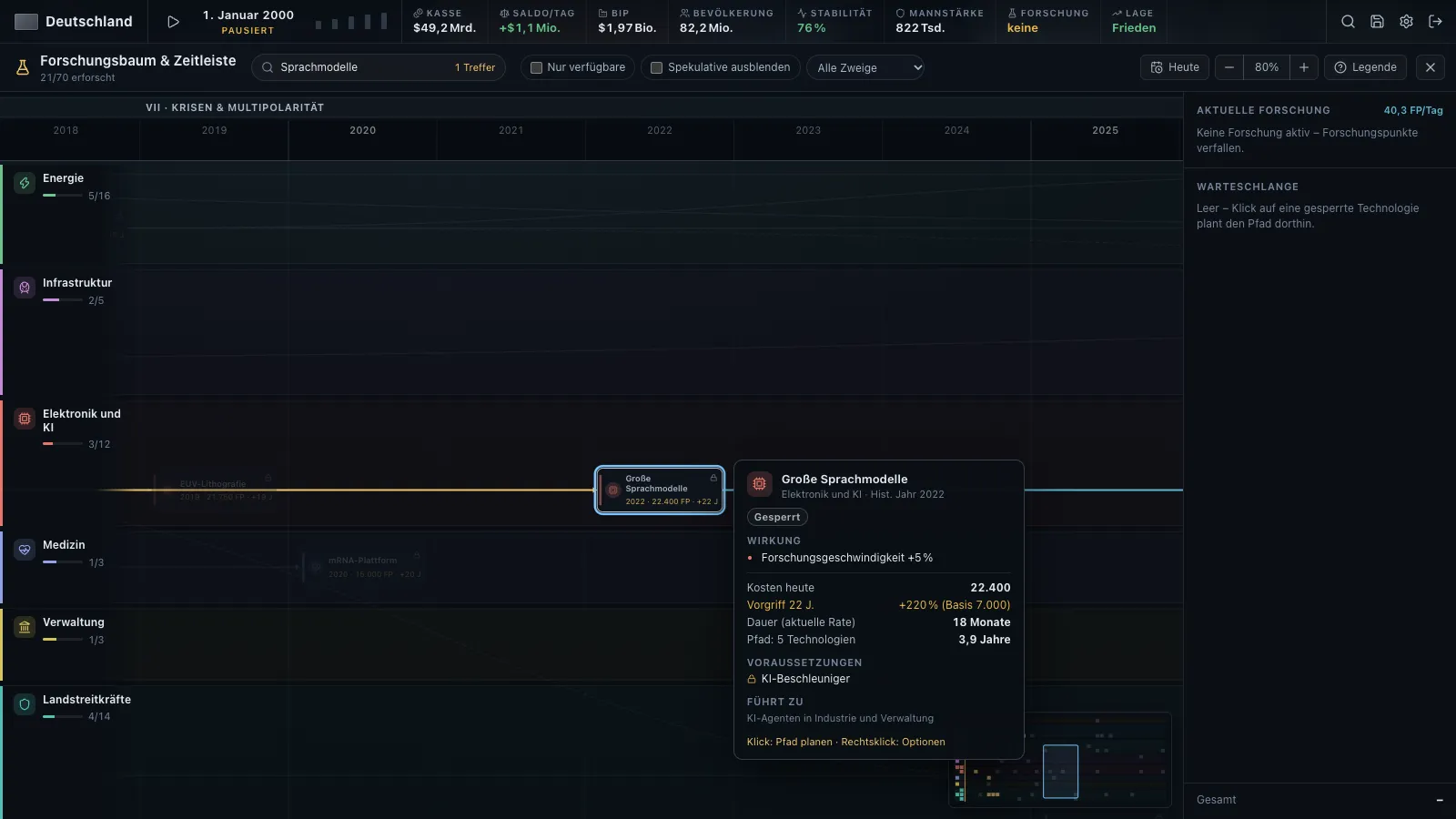
You can research any technology whose prerequisites are met – even years before its historical year. But it costs: the ahead-of-time penalty grows quadratically. One year ahead costs 1.3 times as much, two years twice as much, five years 6.5 times. A lead of more than a few years is practically unaffordable.
Conversely, a technology gets cheaper the further you are behind its year, and cheaper still the more nations already have it (diffusion). This lets poorer states catch up without overtaking the leaders.
For experts: the cost formula
Values: defines from Spec 20 §12 and §14. Research buildings of poorer economies achieve less per level (purchasing power factor).
Points, queue, paths
Research points come from the research budget (F2) and from research buildings such as universities. In the current build a nation researches one technology at a time; progress is kept when you switch.
In the research tree (F5) you click an available technology to research it. Clicking a locked technology plans the path: all missing prerequisites are added to the queue in the right order. On hover, the tree highlights all predecessors in amber and all successors in cyan.
Technologies work in three ways: they unlock production methods, buildings or units, or they grant modifiers – for example on production, services, tax efficiency, stability or research speed.
The speculative future
From 2027 the world becomes fictional. All technologies from this period are marked as speculative – with a dashed border in the tree. Their years and effects are design decisions derived from trends, not predictions. Examples from the game data are green hydrogen (2028), AI agents in industry and administration (2030) and experimental nuclear fusion (2045).
Epochs
Research drives the change of epochs: VI · Globalisation (2000–2008), VII · Crises and Multipolarity (2009–2026), VIII · Near Future (2027–2045) and IX · Mid Future (from 2046). With them, available production methods, important resources and even the look of the interface change. The research tree shows the epochs as bands above the timeline.
Tips
- Do not reach too far ahead: one or two years' lead pays off for key technologies – more rarely does.
- Falling behind is cheap: what others already have costs you less. Focus on what is currently slowing your economy.
- Plan paths: one click on the goal is enough; the queue does the rest.
For now, suggestions go through the Discord channel or the community page.
Derived from the specifications; measurements come from test runs of the prototype and are marked as such.