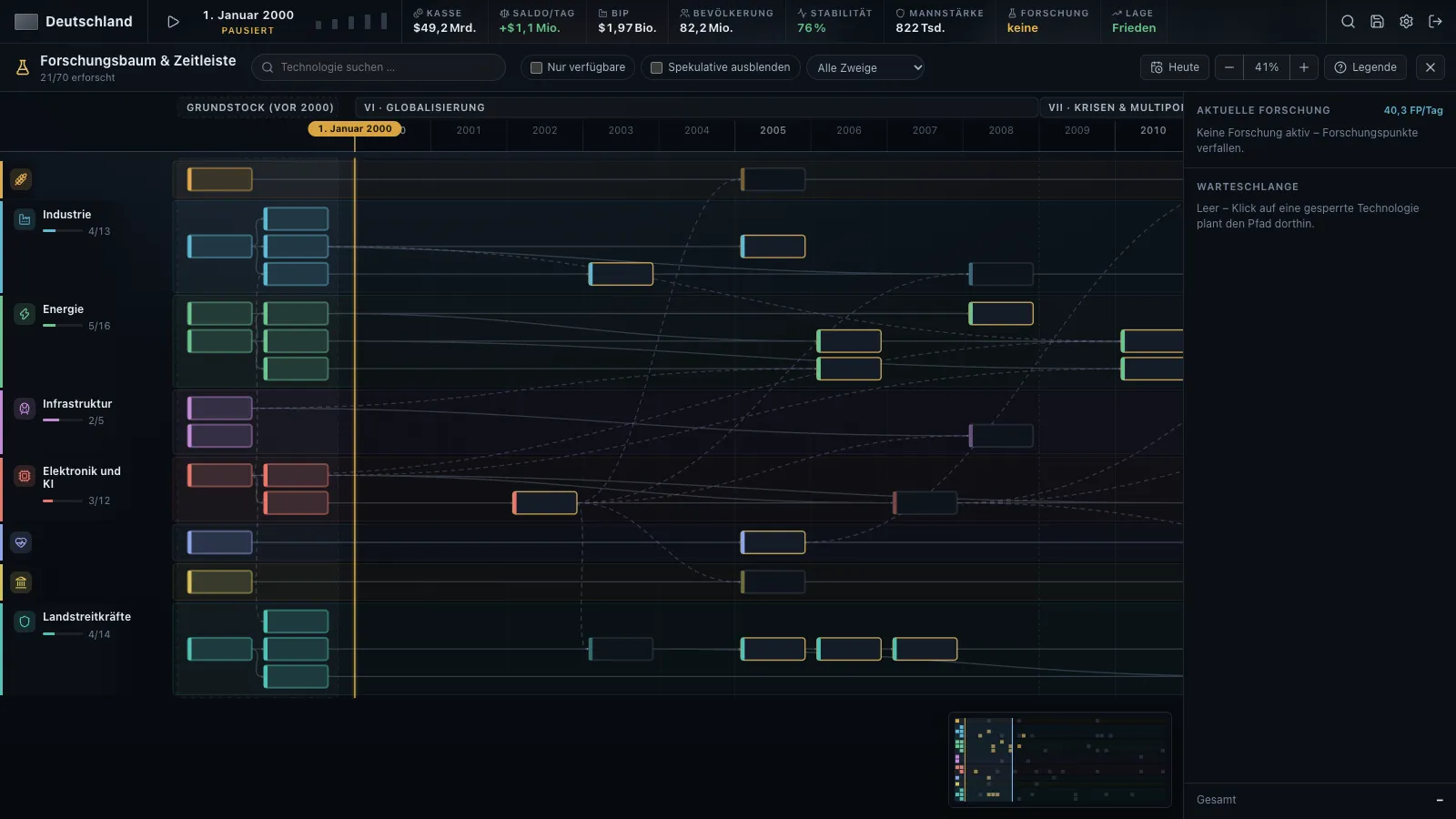
Research & timeline
A tree as a timeline: researching ahead costs more, falling behind gets cheaper through diffusion.
Every technology has a year.
167 technologies in 12 branches, arranged by their historical year. On hover, prerequisites light up amber and follow-up technologies cyan.
- Researching ahead costs. Researching before the historical year adds a surcharge that grows with every year.
- Diffusion helps. If a technology lies in the past or many nations already have it, it gets cheaper.
- Plan paths. Clicking a locked technology queues the whole path.
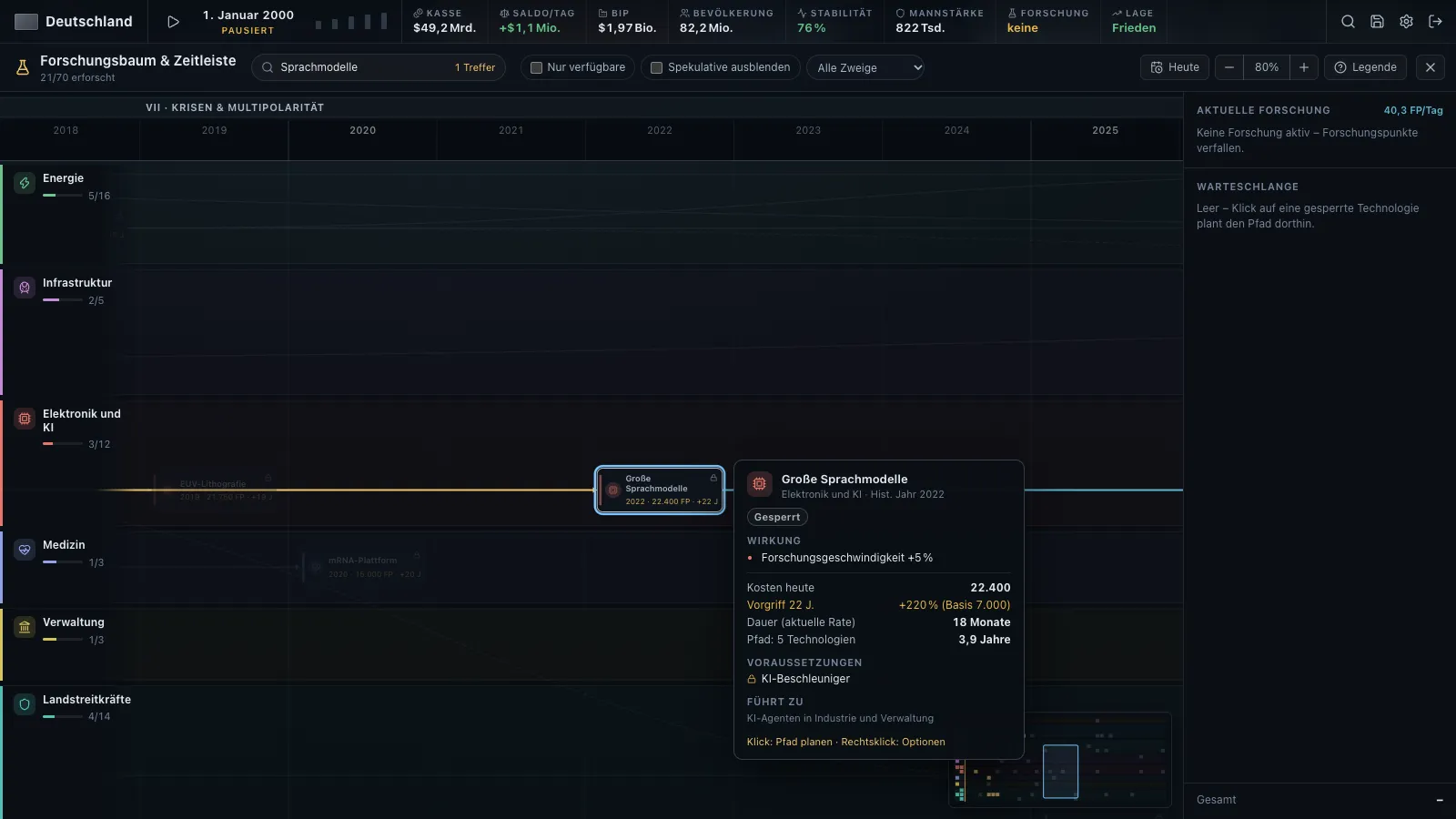
Budget, universities, dual use.
Research points come from the research budget and from research buildings. Technologies unlock production methods, buildings and units or improve values – civilian and military at once.
- Budget with diminishing returns. Points grow with the square root of research spending.
- Research buildings. Universities and institutes provide points depending on their utilisation.
- Progress is kept. Switching the research target does not lose the progress made.
From 2027 the future is a design decision.
Technologies beyond the present are marked as speculative. Their years are design decisions, not predictions.
Energy
Green hydrogen, solid-state batteries, small modular reactors, experimental nuclear fusion.
Electronics and AI
AI agents in industry and administration, 6G mobile networks, general AI assistance, quantum computing applications.
Space
Crewed Moon landing, in-orbit manufacturing, lunar outpost, asteroid exploration.