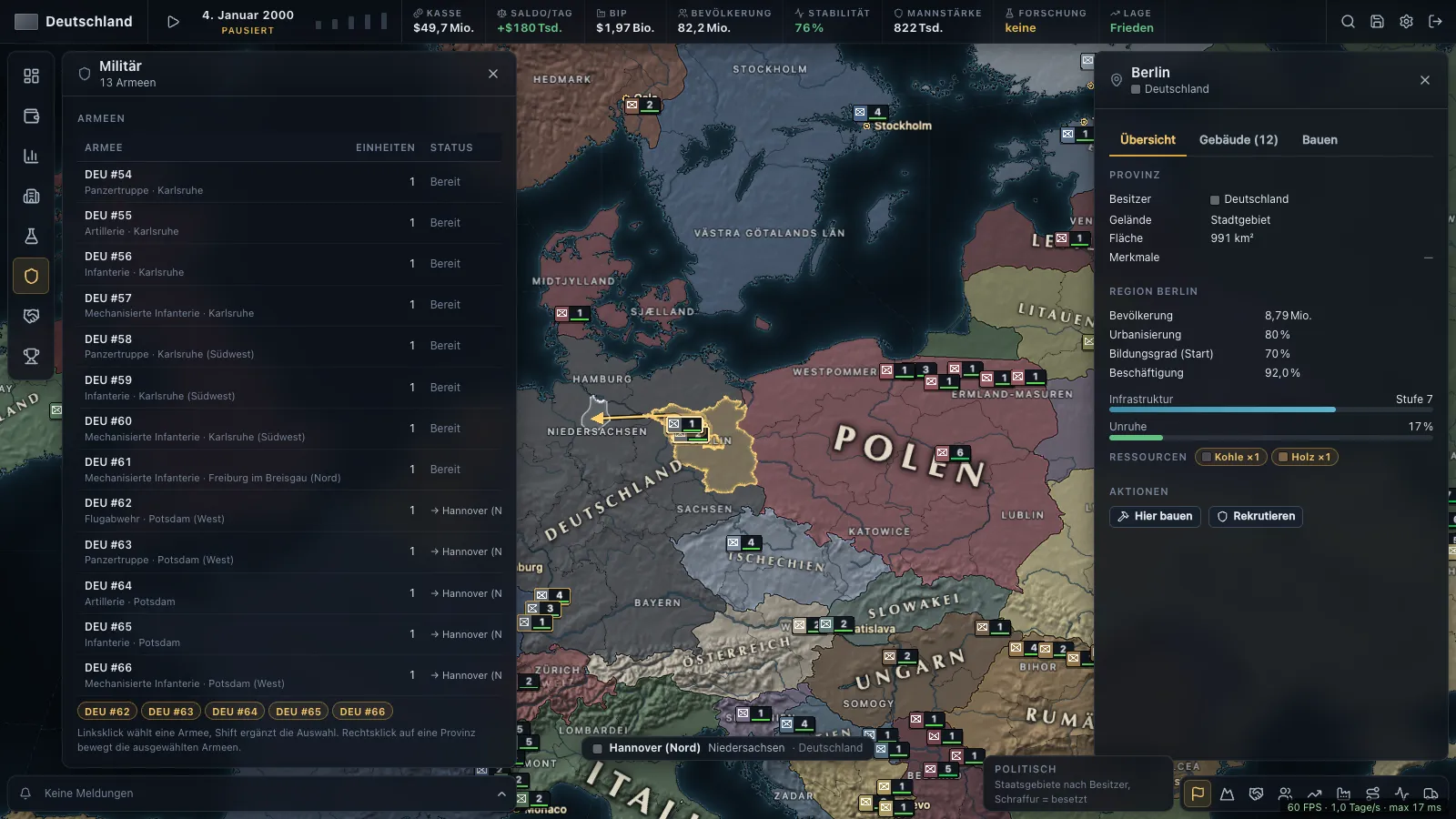
Military
Equipment in generations, fronts, supply over the same network as trade. Deterrence from the start.
Battles with causes.
Armies stand in provinces. In war, fighting happens four times a day: strength, organisation, terrain, supply and luck decide. The result can be broken down.
- Organisation before strength. Losses hit organisation first. Whoever breaks retreats – an encircled army is destroyed.
- Terrain matters. Defenders get the terrain bonus; attacks across rivers and straits are harder.
- Occupation along the front. Besieged provinces change control; ownership only changes with peace. Occupied regions produce less.
The same logistics as trade.
The supply network starts at the capital and your own coasts and reaches only one province beyond the front. Troops consume goods from the national stockpile.
- No supply, no strength. Cut-off armies lose strength and organisation; consumption rises in battle.
- Manpower from the population. Reinforcements need personnel and equipment – both run short in a long war.
- War costs the economy. Upkeep, recruitment and equipment weigh on budget and stockpiles.
From main battle tank to drone.
Three military branches of the research tree change over the decades what armies, air forces and fleets can do.
Land forces
Active protection systems, loitering munitions, counter-drone defence – robotic escort vehicles later (speculative).
Air forces
Armed drones, fifth-generation fighters, hypersonic weapons – loyal wingman from 2030 (speculative).
Naval forces
Air-independent submarines, anti-ship missiles, naval drones – uncrewed fleets later (speculative).
Nuclear weapons matter from day one.
In the 2000 scenario several states already have nuclear weapons. Deterrence is therefore not a late feature. Their use is designed as a risk to the whole game, not as a tool – and can be switched off by a campaign rule.