Terrain
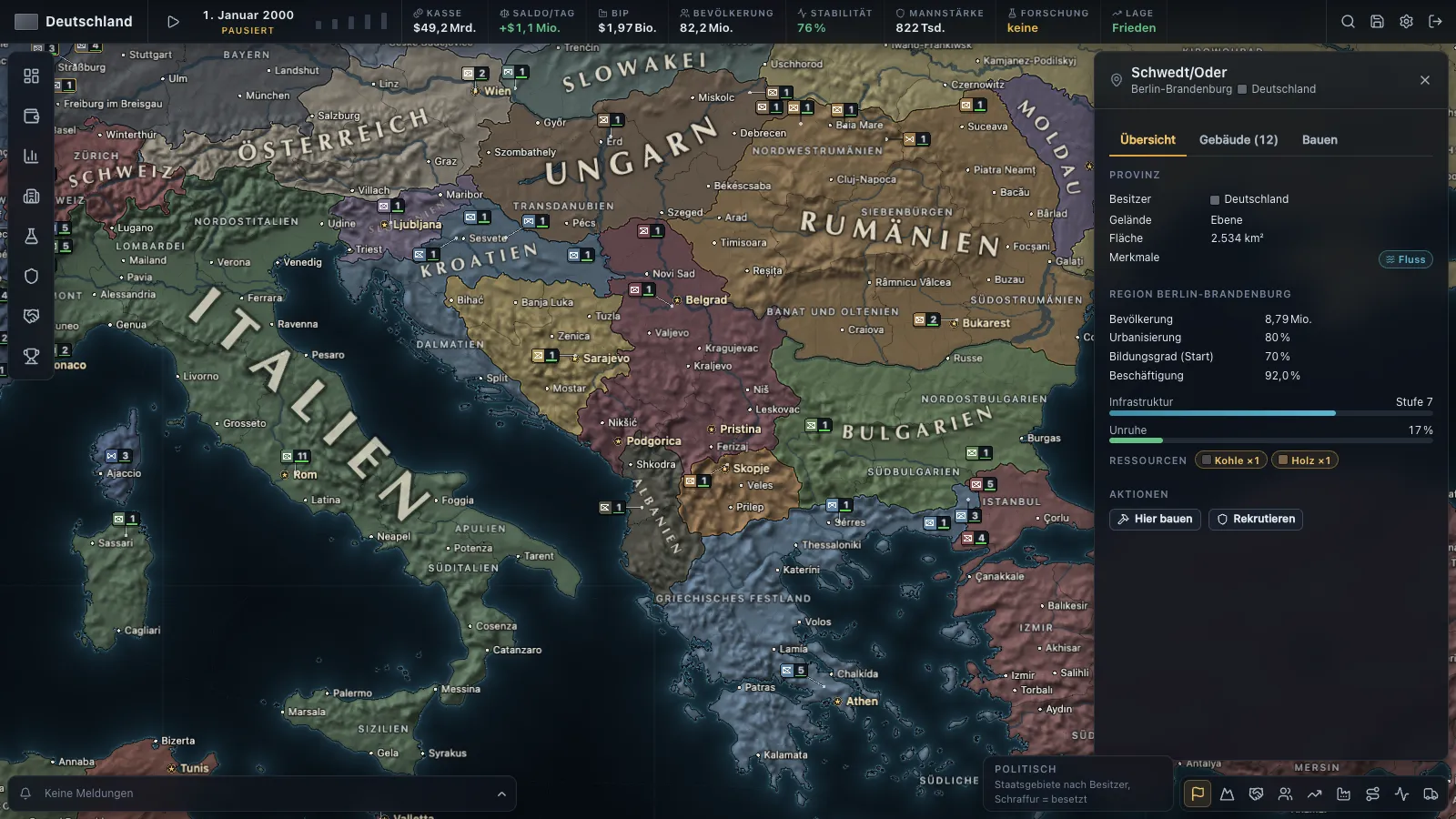
Terrain affects attack, defence and movement per troop class. Frontage limits how many units fight at the same time; the rest waits in reserve.
As of version 0.2.0 What’s new?
Terrain at a glance
| Terrain | Movement cost | Defence bonus | Frontage | Close air support | Attrition without supply | Mechanic |
|---|---|---|---|---|---|---|
| PlainsPlainsTerrainMovement cost×1Defence bonus±0%Frontage12 unitsClose air support×1.15Attrition without supply1%/dayOpen ground: fast movement, a wide front, no defence bonus. Armour, mechanised forces and artillery are at their strongest here, and close air support is amplified. | ×1 | ±0% | 12 units | ×1.15 | 1% | Open ground: fast movement, a wide front, no defence bonus. Armour, mechanised forces and artillery are at their strongest here, and close air support is amplified. |
| FarmlandFarmlandTerrainMovement cost×1Defence bonus±0%Frontage10.8 unitsClose air support×1.1Attrition without supply0.8%/dayDeveloped open land: fast movement, a slightly narrower front than plains, low attrition. Armour, mechanised forces and artillery keep their edge. | ×1 | ±0% | 10.8 units | ×1.1 | 0.8% | Developed open land: fast movement, a slightly narrower front than plains, low attrition. Armour, mechanised forces and artillery keep their edge. |
| ForestForestTerrainMovement cost×1.5Defence bonus+25%Frontage8.4 unitsClose air support×0.7Attrition without supply1.2%/dayForest slows movement, narrows the front and shields the defender. Infantry and light forces fight better, armour and artillery worse; close air support is dampened. | ×1.5 | +25% | 8.4 units | ×0.7 | 1.2% | Forest slows movement, narrows the front and shields the defender. Infantry and light forces fight better, armour and artillery worse; close air support is dampened. |
| HillsHillsTerrainMovement cost×1.5Defence bonus+30%Frontage9 unitsClose air support×0.9Attrition without supply1.2%/dayHills shield the defender and narrow the front a little. Light forces are strong, armour and mechanised forces weaker and slower. | ×1.5 | +30% | 9 units | ×0.9 | 1.2% | Hills shield the defender and narrow the front a little. Light forces are strong, armour and mechanised forces weaker and slower. |
| MountainsMountainsTerrainMovement cost×2.5Defence bonus+60%Frontage4.8 unitsClose air support×0.7Attrition without supply2%/dayMountains are the strongest defensive terrain: very slow, a very narrow front, close air support dampened. Mountain troops shine, tanks fail – superior numbers hold the front here but hardly break it. | ×2.5 | +60% | 4.8 units | ×0.7 | 2% | Mountains are the strongest defensive terrain: very slow, a very narrow front, close air support dampened. Mountain troops shine, tanks fail – superior numbers hold the front here but hardly break it. |
| DesertDesertTerrainMovement cost×1.4Defence bonus±0%Frontage14.4 unitsClose air support×1.25Attrition without supply3%/dayDesert: the widest front and the strongest air effect, but high attrition without supply. Armour and artillery have the edge, infantry is somewhat weaker. | ×1.4 | ±0% | 14.4 units | ×1.25 | 3% | Desert: the widest front and the strongest air effect, but high attrition without supply. Armour and artillery have the edge, infantry is somewhat weaker. |
| SteppeSteppeTerrainMovement cost×1.1Defence bonus±0%Frontage13.2 unitsClose air support×1.2Attrition without supply1.4%/dayWide open grassland: a broad front, strong air effect, little cover. Armour and artillery have the edge, infantry is slightly disadvantaged. | ×1.1 | ±0% | 13.2 units | ×1.2 | 1.4% | Wide open grassland: a broad front, strong air effect, little cover. Armour and artillery have the edge, infantry is slightly disadvantaged. |
| MarshMarshTerrainMovement cost×2Defence bonus+20%Frontage6 unitsClose air support×0.8Attrition without supply2%/dayMarsh: very slow with a narrow front. Marines have the edge here, armour and mechanised forces barely advance. | ×2 | +20% | 6 units | ×0.8 | 2% | Marsh: very slow with a narrow front. Marines have the edge here, armour and mechanised forces barely advance. |
| TundraTundraTerrainMovement cost×1.6Defence bonus+10%Frontage9.6 unitsClose air support×0.9Attrition without supply2.5%/dayTundra: slow, a somewhat narrower front and high attrition without supply. Light forces cope best. | ×1.6 | +10% | 9.6 units | ×0.9 | 2.5% | Tundra: slow, a somewhat narrower front and high attrition without supply. Light forces cope best. |
| UrbanUrbanTerrainMovement cost×1.3Defence bonus+40%Frontage6 unitsClose air support×0.6Attrition without supply0.5%/dayUrban area: a high defence bonus, a narrow front, close air support strongly dampened. Infantry, light forces and marines defend stubbornly, armour is at a disadvantage. | ×1.3 | +40% | 6 units | ×0.6 | 0.5% | Urban area: a high defence bonus, a narrow front, close air support strongly dampened. Infantry, light forces and marines defend stubbornly, armour is at a disadvantage. |
| JungleJungleTerrainMovement cost×2Defence bonus+35%Frontage5.4 unitsClose air support×0.5Attrition without supply2.8%/dayJungle: very slow, a very narrow front, high attrition without supply and little effect from the air. Light forces and marines have the edge, heavy formations are at a clear disadvantage. | ×2 | +35% | 5.4 units | ×0.5 | 2.8% | Jungle: very slow, a very narrow front, high attrition without supply and little effect from the air. Light forces and marines have the edge, heavy formations are at a clear disadvantage. |
Frontage = 12 units × terrain factor. · FrontageFrontageMechanicHow many troops fight at once: 12 units per side × terrain factor. Whatever does not fit stands in reserve – large armies fight longer in narrow terrain, but not harder. · ReserveReserveMechanicTroops that do not fit on the front. They do not fire and lose no strength, but take 10% of the organisation losses – they relieve the front and prolong the battle. · Terrain effectTerrain effectMechanicTerrain affects attack, defence and movement per troop class: tanks win on the plains and fail in the mountains, where light forces are strong. It also sets the frontage and the air effect. · River and strait crossingRiver and strait crossingMechanicAttacking across a river costs firepower (the defender gets a 25% bonus); across a strait it is multiplied by 0.5. Marines bear only part of this penalty.
WaterWaterTerrainSea zones and waters. Land forces only cross by sealift or landing; fleets and sea control decide here. : Sea zones and waters. Land forces only cross by sealift or landing; fleets and sea control decide here.
Matrix: terrain × troop class
Each cell: attack / defence / movement factor. The movement factor multiplies the terrain’s movement cost. · = neutral.
| Terrain | InfantryInfantryTroop classCrossing relief0%Unit types1Infantry: slight advantage in forest, cities and jungle, somewhat weaker in open desert and steppe. | Light forcesLight forcesTroop classCrossing relief0%Unit types0Mountain troops, special forces and light infantry: strong and faster in mountains, hills, forest and jungle. | MarinesMarinesTroop classCrossing relief50%Attack on the coast+10%Unit types1Marines: advantage in marshes and on the coast, suffer only half the river and strait crossing penalty. | MechanisedMechanisedTroop classCrossing relief0%Unit types3Mechanised formations: strong in open terrain, weaker and slower in forest, marsh, jungle, mountains and cities. | ArmourArmourTroop classCrossing relief0%Unit types1Armour: decisive on plains, steppe and desert; markedly weaker and slower in forest, marsh, jungle, mountains and cities. | ArtilleryArtilleryTroop classCrossing relief0%Unit types2Artillery and drones: strong with open fields of fire on plains, steppe and desert, weak in jungle, marsh and mountains. | SupportSupportTroop classCrossing relief0%Unit types2Air defence and coastal missiles: neutral in combat, slower in difficult terrain. |
|---|---|---|---|---|---|---|---|
| PlainsPlainsTerrainMovement cost×1Defence bonus±0%Frontage12 unitsClose air support×1.15Attrition without supply1%/dayOpen ground: fast movement, a wide front, no defence bonus. Armour, mechanised forces and artillery are at their strongest here, and close air support is amplified. | · | · | · | +10% / ±0% / ×1 | +20% / +5% / ×1 | +15% / ±0% / ×1 | · |
| FarmlandFarmlandTerrainMovement cost×1Defence bonus±0%Frontage10.8 unitsClose air support×1.1Attrition without supply0.8%/dayDeveloped open land: fast movement, a slightly narrower front than plains, low attrition. Armour, mechanised forces and artillery keep their edge. | · | · | · | +5% / ±0% / ×1 | +10% / ±0% / ×1 | +10% / ±0% / ×1 | · |
| ForestForestTerrainMovement cost×1.5Defence bonus+25%Frontage8.4 unitsClose air support×0.7Attrition without supply1.2%/dayForest slows movement, narrows the front and shields the defender. Infantry and light forces fight better, armour and artillery worse; close air support is dampened. | +10% / +10% / ×1 | +15% / +15% / ×0.85 | ±0% / +5% / ×1 | −15% / −5% / ×1.2 | −30% / −15% / ×1.3 | −15% / −10% / ×1.2 | ±0% / ±0% / ×1.1 |
| HillsHillsTerrainMovement cost×1.5Defence bonus+30%Frontage9 unitsClose air support×0.9Attrition without supply1.2%/dayHills shield the defender and narrow the front a little. Light forces are strong, armour and mechanised forces weaker and slower. | ±0% / +5% / ×1 | +20% / +15% / ×0.8 | · | −10% / ±0% / ×1.1 | −20% / −5% / ×1.2 | ±0% / +5% / ×1.1 | ±0% / ±0% / ×1.1 |
| MountainsMountainsTerrainMovement cost×2.5Defence bonus+60%Frontage4.8 unitsClose air support×0.7Attrition without supply2%/dayMountains are the strongest defensive terrain: very slow, a very narrow front, close air support dampened. Mountain troops shine, tanks fail – superior numbers hold the front here but hardly break it. | ±0% / +5% / ×1 | +35% / +25% / ×0.7 | −5% / ±0% / ×1 | −30% / −15% / ×1.3 | −50% / −30% / ×1.5 | −30% / −10% / ×1.4 | −10% / ±0% / ×1.3 |
| DesertDesertTerrainMovement cost×1.4Defence bonus±0%Frontage14.4 unitsClose air support×1.25Attrition without supply3%/dayDesert: the widest front and the strongest air effect, but high attrition without supply. Armour and artillery have the edge, infantry is somewhat weaker. | −10% / −5% / ×1 | · | −5% / ±0% / ×1 | +10% / +5% / ×0.9 | +25% / +10% / ×0.9 | +20% / ±0% / ×1 | · |
| SteppeSteppeTerrainMovement cost×1.1Defence bonus±0%Frontage13.2 unitsClose air support×1.2Attrition without supply1.4%/dayWide open grassland: a broad front, strong air effect, little cover. Armour and artillery have the edge, infantry is slightly disadvantaged. | −5% / −5% / ×1 | · | · | +10% / +5% / ×0.95 | +25% / +5% / ×0.95 | +20% / ±0% / ×1 | · |
| MarshMarshTerrainMovement cost×2Defence bonus+20%Frontage6 unitsClose air support×0.8Attrition without supply2%/dayMarsh: very slow with a narrow front. Marines have the edge here, armour and mechanised forces barely advance. | ±0% / +5% / ×1 | +5% / +5% / ×0.9 | +25% / +15% / ×0.7 | −30% / −15% / ×1.5 | −45% / −25% / ×1.7 | −25% / −10% / ×1.4 | −10% / ±0% / ×1.3 |
| TundraTundraTerrainMovement cost×1.6Defence bonus+10%Frontage9.6 unitsClose air support×0.9Attrition without supply2.5%/dayTundra: slow, a somewhat narrower front and high attrition without supply. Light forces cope best. | · | +10% / +10% / ×0.85 | · | −10% / ±0% / ×1.1 | −15% / −5% / ×1.15 | −5% / ±0% / ×1.1 | ±0% / ±0% / ×1.1 |
| UrbanUrbanTerrainMovement cost×1.3Defence bonus+40%Frontage6 unitsClose air support×0.6Attrition without supply0.5%/dayUrban area: a high defence bonus, a narrow front, close air support strongly dampened. Infantry, light forces and marines defend stubbornly, armour is at a disadvantage. | +15% / +20% / ×1 | +15% / +15% / ×1 | +10% / +10% / ×1 | −10% / ±0% / ×1 | −30% / −20% / ×1.2 | −10% / −10% / ×1 | ±0% / +5% / ×1 |
| JungleJungleTerrainMovement cost×2Defence bonus+35%Frontage5.4 unitsClose air support×0.5Attrition without supply2.8%/dayJungle: very slow, a very narrow front, high attrition without supply and little effect from the air. Light forces and marines have the edge, heavy formations are at a clear disadvantage. | +5% / +10% / ×1 | +25% / +20% / ×0.75 | +15% / +10% / ×0.85 | −35% / −20% / ×1.4 | −50% / −35% / ×1.6 | −35% / −20% / ×1.4 | −10% / ±0% / ×1.3 |
Troop classes
InfantryInfantryTroop classCrossing relief0%Unit types1Infantry: slight advantage in forest, cities and jungle, somewhat weaker in open desert and steppe.
Infantry: slight advantage in forest, cities and jungle, somewhat weaker in open desert and steppe.
- Crossing relief
- 0%
- Attack on the coast
- ±0%
- Units
- InfantryInfantryArmy · InfantryAttack4Defence6Speed25 km/dayCost$160MBuild time120 daysUpkeep$300k/dayThe backbone of every army: cheap, strong in defence, needs little fuel. Good in forest, cities and jungle, weaker in open desert and steppe.
Light forcesLight forcesTroop classCrossing relief0%Unit types0Mountain troops, special forces and light infantry: strong and faster in mountains, hills, forest and jungle.
Mountain troops, special forces and light infantry: strong and faster in mountains, hills, forest and jungle.
- Crossing relief
- 0%
- Attack on the coast
- ±0%
- Units
- –
MarinesMarinesTroop classCrossing relief50%Attack on the coast+10%Unit types1Marines: advantage in marshes and on the coast, suffer only half the river and strait crossing penalty.
Marines: advantage in marshes and on the coast, suffer only half the river and strait crossing penalty.
- Crossing relief
- 50%
- Attack on the coast
- +10%
- Units
- Marine BrigadeMarine BrigadeArmy · MarinesAttack7Defence6Speed30 km/dayCost$600MBuild time180 daysUpkeep$1.1M/dayMarines: trained for landings, suffer less from the landing penalty and bear only half of river and strait crossing penalties. Strong in marshes and on coasts.
MechanisedMechanisedTroop classCrossing relief0%Unit types3Mechanised formations: strong in open terrain, weaker and slower in forest, marsh, jungle, mountains and cities.
Mechanised formations: strong in open terrain, weaker and slower in forest, marsh, jungle, mountains and cities.
- Crossing relief
- 0%
- Attack on the coast
- ±0%
- Units
- Mechanised InfantryMechanised InfantryArmy · MechanisedAttack8Defence8Speed40 km/dayCost$880MBuild time180 daysUpkeep$1.6M/dayInfantry in armoured vehicles: faster and stronger in attack than foot troops, needs more fuel. Strong in open terrain, slower in forest, marsh and mountains. , Robotic BrigadeRobotic BrigadeArmy · MechanisedAttack16Defence10Speed45 km/dayCost$1.4bnBuild time300 daysUpkeep$2.5M/dayRobotic brigade: uncrewed combat vehicles with high firepower and few personnel. In terrain like mechanised forces. , Autonomous BrigadeAutonomous BrigadeArmy · MechanisedAttack22Defence14Speed50 km/dayCost$1.6bnBuild time300 daysUpkeep$3M/dayAutonomous brigade: networked, largely self-directed formations – the strongest ground forces. In terrain like mechanised forces.
ArmourArmourTroop classCrossing relief0%Unit types1Armour: decisive on plains, steppe and desert; markedly weaker and slower in forest, marsh, jungle, mountains and cities.
Armour: decisive on plains, steppe and desert; markedly weaker and slower in forest, marsh, jungle, mountains and cities.
- Crossing relief
- 0%
- Attack on the coast
- ±0%
- Units
- ArmourArmourArmy · ArmourAttack14Defence9Speed35 km/dayCost$1.8bnBuild time240 daysUpkeep$3.2M/dayArmour: the strongest attacking force on plains, steppe and desert. Clearly weaker and slower in forest, marsh, jungle, mountains and cities – there the terrain decides.
ArtilleryArtilleryTroop classCrossing relief0%Unit types2Artillery and drones: strong with open fields of fire on plains, steppe and desert, weak in jungle, marsh and mountains.
Artillery and drones: strong with open fields of fire on plains, steppe and desert, weak in jungle, marsh and mountains.
- Crossing relief
- 0%
- Attack on the coast
- ±0%
- Units
- ArtilleryArtilleryArmy · ArtilleryAttack12Defence3Speed25 km/dayCost$710MBuild time150 daysUpkeep$1.3M/dayArtillery adds firepower to an attack but defends itself poorly. Most effective with a clear field of fire on plains, steppe and desert. , Drone BattalionDrone BattalionArmy · ArtilleryAttack9Defence2Speed40 km/dayCost$490MBuild time120 daysUpkeep$900k/dayDrone battalion with loitering munitions: high firepower at low cost, hardly any defence. Fights in terrain like artillery.
SupportSupportTroop classCrossing relief0%Unit types2Air defence and coastal missiles: neutral in combat, slower in difficult terrain.
Air defence and coastal missiles: neutral in combat, slower in difficult terrain.
- Crossing relief
- 0%
- Attack on the coast
- ±0%
- Units
- Air DefenceAir DefenceArmy · SupportAttack2Defence6Speed30 km/dayCost$1.2bnBuild time210 daysUpkeep$2.2M/dayGround-based air defence: counts towards the air defence of its region and protects against air strikes and missiles. Hardly any attack value in ground combat. , Coastal Missile BatteryCoastal Missile BatteryArmy · SupportAttack3Defence8Speed30 km/dayCost$660MBuild time240 daysUpkeep$1.2M/dayCoastal missiles: defend the coast and add to sea control in adjacent sea zones.